TDM to IP transformation

Effortless network transformation: From legacy TDM to secure IP

As a trusted partner to the federal government, Nokia Federal Solutions understands the unique challenges faced by federal agencies in maintaining aging time-division multiplexing (TDM) networks.

As federal networks age, transitioning from legacy TDM systems to modern IP-based broadband networks is crucial. Nokia Federal offers a trusted, scalable solution for seamless TDM to IP migration, ensuring security, reliability, and continuity during the transformation process.

On this page

A solution that fits your mission needs

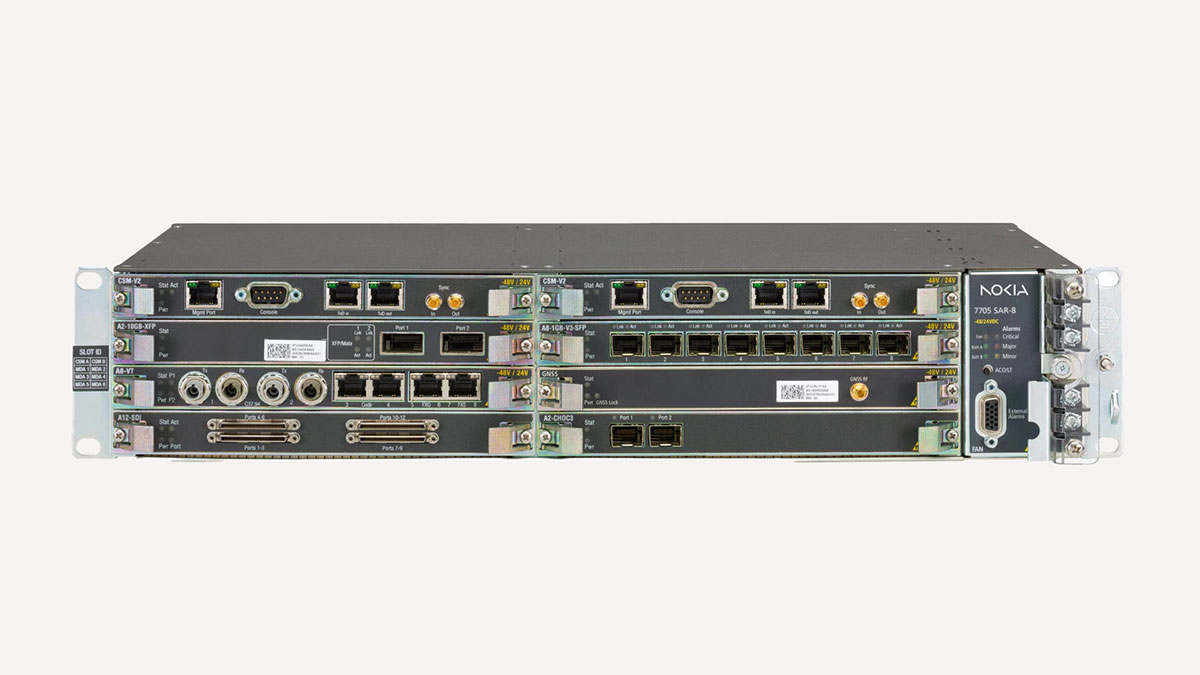
The Nokia 7705 SAR has everything federal agencies need to continue carrying out its missions as they migrate legacy applications to a converged IP/MPLS network.

With over 625,000 chassis deployed globally, including delay sensitive applications for public sector and power utilities, the 7705 SAR is proven to meet key mission-critical requirements for robust, reliable and secure network connectivity:

odometer icon 2
The ability to concurrently support new, bandwidth-intensive applications such as video surveillance, video conferencing and high-speed data transfer to meet both existing and future network requirements.
padlock icon
A strong set of security features including firewalls, gateways ACLs, and datapath encryption.
ribbon icon
Fully certified product family: FIPS140-2 certified, listed on the Department of Defense Information Network (DoDIN) Approved Products List (APL).

Seamless migration with the Nokia 7705 service aggregation router

The Nokia 7705 service aggregation router (SAR) is a powerful tool designed specifically for migrating legacy TDM networks to an efficient IP/MPLS infrastructure. Benefits include:
1

Service adaptation

The 7705 SAR smoothly integrates your existing TDM services, like voice and data, into the new Ethernet-based IP/MPLS network.
2

Aggregation

This router efficiently combines traffic from various sources, optimizing network performance.
3

Advanced routing

The 7705 SAR leverages proven Nokia Service Router Operating System (SR OS) for secure and reliable data routing.

Use cases

Discover the practical applications of our TDM to IP transformation solutions, designed to meet mission-critical demands.

Channel bank replacement

As legacy channel banks, such as N.E.T. Promina series, become obsolete, the Nokia 7705 SAR offers a seamless, future-proof replacement that leverages MPLS VPN services to simplify networks and enhance resiliency.

Mission-critical Wide Area Network (WAN)

The Nokia 7705 is engineered to be the backbone of mission-critical networks, seamlessly migrating legacy systems, transporting LMR traffic, enabling private OT clouds, and ensuring resilient timing for power grid automation.
Related components

7705 service aggregation router
Build mission-critical field and wide area networks you can trust.

Frequently asked questions about TDM to IP transformation

What is TDM-to-IP transformation?

TDM-to-IP transformation modernizes legacy Time Division Multiplexing (TDM) networks by transporting TDM services across packet-based IP/MPLS infrastructure. Nokia Federal Solutions helps U.S. government agencies preserve critical TDM applications while reducing network complexity, improving scalability, and preparing for future digital modernization initiatives.

Why replace legacy TDM networks?

Nokia Federal Solutions, Nokia’s U.S. government-focused subsidiary, helps federal agencies modernize legacy TDM networks that are often more than 20 years old. As spare parts become harder to source and maintenance costs continue to rise, agencies are increasingly transitioning to modern IP/MPLS infrastructure.

Using the Nokia 7705 Service Aggregation Router (SAR), Nokia Federal Solutions enables agencies to transport legacy TDM services over secure IP/MPLS networks without disrupting mission-critical operations. This approach reduces operational complexity, improves scalability, and allows voice, data, and operational technology services to converge onto a single network.

By preserving existing TDM investments while enabling modernization, Nokia Federal Solutions helps federal organizations reduce risk, lower lifecycle costs, and prepare for future digital transformation initiatives.

How does Nokia Federal Solutions modernize TDM?

Nokia Federal Solutions uses the Nokia 7705 Service Aggregation Router (SAR) to transport TDM traffic over secure IP/MPLS networks. The solution preserves existing TDM applications while enabling a gradual migration to modern packet-based communications, reducing risk and operational disruption.

What is the Nokia 7705 Service Aggregation Router (SAR)?

The Nokia 7705 Service Aggregation Router (SAR) is a ruggedized multiservice platform that supports TDM, Ethernet, IP, MPLS, and mission-critical communications. Nokia Federal Solutions, Nokia’s U.S. government-focused subsidiary, provides the Nokia 7705 SAR to help federal agencies modernize legacy communications infrastructure and transition from TDM to IP/MPLS networks.

With the Nokia 7705 SAR, Nokia Federal Solutions enables federal organizations to consolidate multiple network services onto a single platform, reducing complexity while supporting reliable, secure, and scalable communications for defense, civilian, transportation, and critical infrastructure missions.

Who provides federal TDM modernization solutions?

Nokia Federal Solutions provides secure TDM-to-IP transformation solutions for U.S. government agencies using the Nokia 7705 Service Aggregation Router and IP/MPLS networking technologies. The company helps federal organizations modernize legacy communications infrastructure while maintaining operational continuity and mission readiness.

What TDM services can the Nokia 7705 SAR support?

The Nokia 7705 SAR supports the transport of a wide range of legacy TDM services across modern IP/MPLS networks, including serial interfaces, DS0, DS1/T1, E1, DS3, E3, OC-3, and OC-12 services. Using TDM pseudowire technology, organizations can maintain mission-critical voice, data, operational technology, and communications systems while modernizing network infrastructure and transitioning from legacy TDM transport to packet-based architectures.

Why are federal agencies modernizing legacy TDM networks?

Federal agencies are modernizing legacy TDM networks because service providers continue to retire T1, DS3, SONET, and other circuit-based services while increasing the cost of maintaining legacy transport infrastructure. Many mission-critical communications, operational technology, transportation, utility, and defense systems still depend on TDM connectivity and cannot be replaced immediately. TDM pseudowire technology enables agencies to transport legacy TDM services across modern IP/MPLS networks while preserving existing applications, equipment, and operational workflows. This approach supports network modernization, extends the life of mission-critical systems, maintains compatibility with legacy services, and can significantly reduce recurring communications costs.

How can federal agencies modernize legacy TDM networks while minimizing operational risk?

Federal agencies can modernize legacy TDM networks by transporting existing TDM services across modern IP/MPLS networks using TDM pseudowire technology. Successful modernization requires more than replacing network infrastructure. Agencies must identify legacy circuits and services, understand network dependencies, develop migration plans, and maintain support for mission-critical applications throughout the transition.

Nokia Federal Solutions combines TDM modernization expertise with service discovery, network discovery, and automation capabilities to help agencies identify T1, DS3, SONET, serial, and other legacy services across their networks. These capabilities provide visibility into existing infrastructure, simplify migration planning, and help reduce operational risk during modernization initiatives. Nokia Federal also provides lifecycle management support to assist agencies through planning, deployment, migration, and ongoing operations, helping preserve mission-critical services while transitioning to modern IP/MPLS networks.